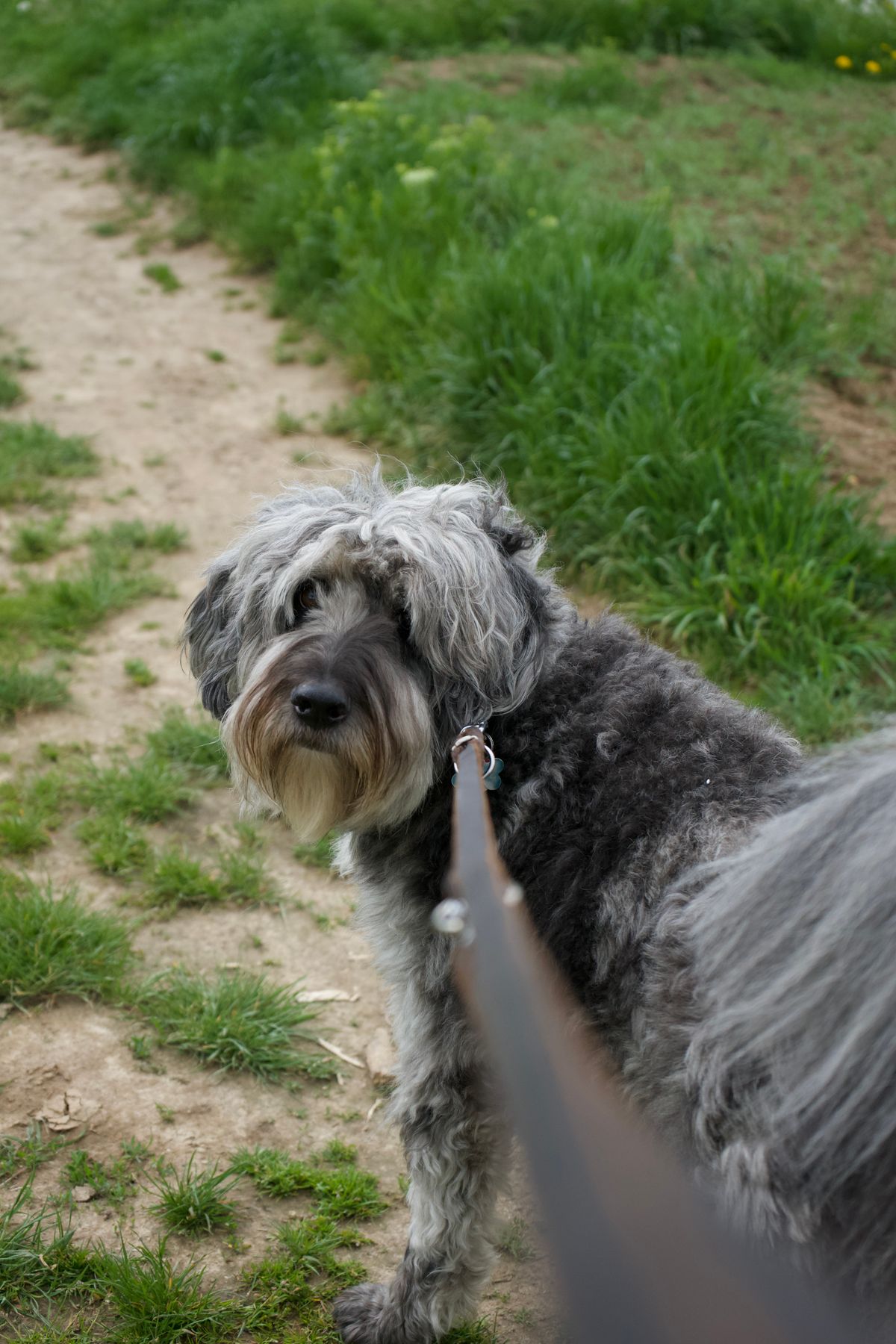
A dog yawning on a walk is not tired: yawning is stress, and on a walk it usually means mild discomfort or a brain working hard, which can actually be a good sign.
I get this question mid-session all the time. A dog yawns halfway through an exercise, the owner says "oh, she's getting sleepy", and I ask them what they think yawning means. The answer is always the same: either stress or tired. Never tired. Stress. Dogs sleep 16 to 18 hours a day. They are not short on naps. If your dog yawns on a walk, the walk is doing something to her brain, and your job is to work out what.
Stress is not a dirty word
Owners hear "stress yawn" and panic, because the word stress has such a negative connotation. I don't use it that way. Stress is a perception, and it runs on a scale. Zero stress is bad for you. Think about what happens when a teenager has zero rules and zero challenge. Too much stress is bad for you too. The good challenging kind in the middle is how anything improves, in dogs and in people. Most of the time I don't even call it stress. I call it pressure.
A yawn sits at the mild end of that scale. It says "I'm slightly uncomfortable with this situation" or "this is hard and I'm thinking". A yawn does not say panic. A dog who is genuinely overwhelmed doesn't yawn. They shut down, or they fall apart completely. So the yawn itself should reassure you: a yawning dog is still coping, still processing, still in the game.
The learning yawn
"I love dogs that yawn when they're learning."
I say that in sessions and owners look at me sideways. But picture a student frowning at a maths problem. The frown is not suffering. It is a brain sitting at exactly the right level of challenge. The learning yawn is your dog's version of that frown, and when I see it during an exercise I am pleased, because the difficulty is set correctly.
Good training raises difficulty in grades. If a dog was at grade zero, I want him at grade one. Not grade five. One. At grade one he is a bit stressed, because he is working something out: oh, I'm challenged. Okay. He is not having a panic attack. That gap, challenged but never panicking, is where all the learning happens. The yawn is often your proof that you're standing in it.
Why she yawns more with one of you
Here is the part owners never expect: the yawn has a handler signature. In a recent session, a young dog yawned far more with her regular handler than she did with me. He wasn't doing anything wrong. He was doing what most of us do, changing the rules a little every day. With me the rules had been identical since the minute we met, so there was nothing to puzzle over. With him, she was standing there going: you weren't like this this morning. What changed?
Consistency is invisible in the human and visible in the dog. If your dog yawns more with one person in the household, that is not an insult to that person. It is information. Their rules are moving around, and the dog is spending brainpower keeping up.
What to do when you see one
Nothing dramatic. Please don't throw a reassurance party. Crouching down with "it's okay, it's okay" tells your dog the moment is worth worrying about, which is the opposite of what you want. What you don't make a big deal of, your dog learns not to make a big deal of either.
Just note the level and adjust. If the yawn shows up while your dog is learning something new, you are at the right grade. Keep going, and keep your praise flat: well done, keep going. Not WELL DONE followed by a party. If the yawns start stacking with other signs, the dog stops sniffing, stops taking the world in, gets slow to respond, then the grade is too high. Make the task one notch easier or move somewhere quieter, and carry on. You don't end the walk. You adjust it.
Read the change, read the whole dog
Two rules sit over every signal I teach, and the yawn is no exception. You read for a change, not a fixed pose. And you read everything in context, because no body part means anything on its own. A yawn from a dog who just woke up from a nap in the sun means nothing. A yawn from a dog standing at the edge of a busy market means something. Same action, different dog underneath it.
The yawn has plenty of company in the misread pile. The lip lick is the classic: the slow windscreen-wiper lick that wets the nose comes with sniffing and searching, while the fast, tight lick comes from a mouth that fear has dried out. Same tongue, opposite meanings. The shake-off is another: after a swim it is water, after a tense moment it is your dog closing the chapter and resetting, and that one I am usually happy to see. If you want the full tour of the body, start with reading your dog's body language, and to see where a walk fits in a structured day, read the four modes.
So next time your dog yawns on a walk, don't turn for home. Look at the whole dog. If she is working on something and coping, that yawn is a frown over a maths problem, and I'd be pleased with both of you. If the yawns are piling up and the dog behind them is going quiet, drop a grade. And if you can't tell which one you're looking at, that reading skill is most of what I teach in private training. Half the job is training you to see what your dog has been saying all along.